D.B. Cooper and the unresolved skyjacking
A man using the name Dan Cooper hijacked a Boeing 727, collected $200,000 and parachuted into the night over the Pacific Northwest. His identity and fate remain unknown.
- Period
- 1971
- Location
- Pacific Northwest
- Case status
- Unresolved; FBI active investigation closed in 2016
A one-way ticket under an assumed name
On November 24, 1971, a man calling himself Dan Cooper bought a cash ticket from Portland, Oregon, to Seattle. After takeoff, he handed a flight attendant a note and showed what appeared to be a bomb. He demanded $200,000, four parachutes and a fuel truck. The aircraft landed in Seattle, passengers were released and the ransom and equipment were delivered. News reporting later introduced the name “D.B. Cooper,” an error that became permanent in public memory.
The jump from a Boeing 727
Cooper ordered the remaining crew to fly toward Mexico at low altitude with the rear stairway lowered. Somewhere over southwestern Washington, he jumped into darkness with the ransom. Weather was poor, the terrain difficult and the clothing observed on him poorly suited to wilderness survival. The crew landed safely in Reno, where investigators searched the aircraft and recovered items including a black tie. No confirmed parachute, body or complete ransom cache was found.
Searches, suspects and physical evidence
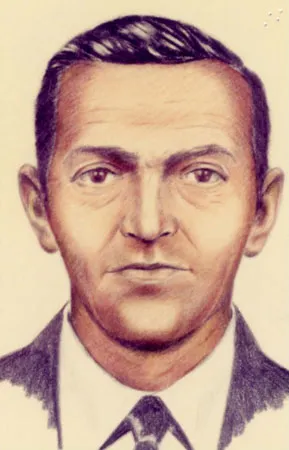
The FBI opened a massive investigation known as NORJAK, interviewing witnesses, examining the aircraft, tracing serial numbers and evaluating hundreds of suspects. Composite sketches reflected witness descriptions but could not establish identity. In 1980, a child found $5,800 in deteriorating ransom bills along the Columbia River; serial numbers matched Cooper’s money. The discovery proved that a small part of the ransom reached the river area but did not explain whether Cooper survived, where he landed or how the bills arrived there.
Aviation security changed
The hijacking exposed vulnerabilities in an era when passengers could board with minimal screening and rear stairs could be deployed in flight. Airlines later installed a device commonly called the Cooper vane to prevent a Boeing 727’s aft stairway from being lowered while airborne. Broader screening and anti-hijacking measures also expanded during the 1970s. Cooper’s crime therefore had consequences beyond the unresolved identity: it influenced the physical design and operating security of commercial aviation.
An unresolved case, not an empty record
In 2016, the FBI redirected resources from active investigation while preserving evidence for examination if a specific item emerged. That administrative decision did not identify Cooper or prove death. Many proposed suspects have attracted books and documentaries, but none has been publicly established by a complete evidentiary chain. A reliable account separates the narrow facts—ticket, threat, ransom, jump and recovered bills—from theories about survival or identity. The enduring mystery is partly the result of that limited but tangible record: enough evidence to reconstruct the act, not enough to name the person.
Reading the historical record
The evidence is finite but unusually durable: passenger and crew descriptions, the aircraft, the tie, ransom serial numbers and the bills recovered in 1980. None establishes a named suspect. Proposed identities often begin with resemblance or biography and then interpret gaps as confirmation. The FBI’s decision to suspend active work did not endorse any of those theories. A credible resolution would require specific physical evidence with provenance, not simply a person who possessed parachuting experience or disappeared at a convenient time.
Reader comments.
Keep it respectful and relevant to the report. No personal information, harassment or unsupported accusations. Comments are readers’ views.
Loading your sign-in status…